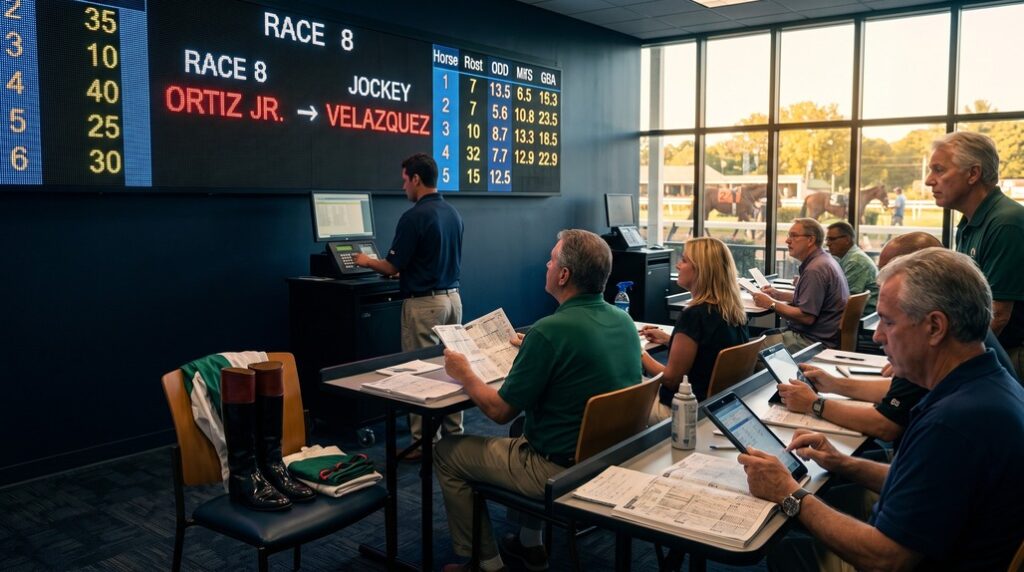
Aqueduct Racetrack’s final live racing day on Sunday, June 28, 2026, closed more than a historic Queens venue. It changed the map for New York horseplayers. After 132 years, live racing ended at the Big A, leaving New York Racing Association racing to move through Saratoga Race Course this summer and the rebuilt Belmont Park this fall. NYRA says Aqueduct will remain open for simulcasting through September 7, but the daily handicapping identity that came with winter and spring racing in South Ozone Park is finished. NYRA’s Aqueduct farewell page confirms the final weekend dates, the final race-day structure, and the end of live racing at the track.
For bettors, this is not just a sentimental goodbye. It affects track-bias notes, winter-racing habits, local barn evaluation, New York-bred form, public money, and how the circuit will price races once Belmont Park reopens. Racebook Review readers who followed the broader horse racing consumer confidence debate already know the sport’s business questions often land directly on the betting product. Aqueduct’s closure is one of those moments: it removes a familiar wagering environment and forces horseplayers to rebuild assumptions around a new downstate structure.
Why Aqueduct’s Closing Day Was More Than A Farewell
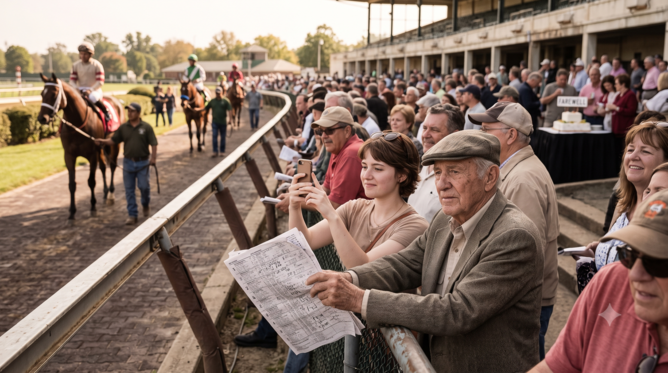
NYRA built Aqueduct’s closing weekend around the track’s history. The farewell event ran Saturday, June 27, and Sunday, June 28, with commemorative programming, honorary race names, an art gallery, and ticketed attendance. The final race on June 28 was named “It Was a Good Run” and was scheduled as the ninth race with a 5:44 p.m. Eastern post time. That detail matters because NYRA did not treat the close as a routine meet-ending. It marked the end of a New York racing venue that opened to the public on September 27, 1894.
The day carried real racing weight too. NYRA’s press office reported that Highway Harmony won the $150,000 John Hettinger Stakes in course-record time on June 28, becoming the final stakes winner in Aqueduct’s history. NYRA’s John Hettinger recap gives the final card a useful handicapping footnote: the end came on a day when performance, surface condition, and historical context all overlapped.
Closing-day nostalgia can hide the betting significance. Aqueduct was not Saratoga. It was not the showcase version of New York racing that pulls national attention every summer. It was the track where many bettors built routine opinions through colder months, shorter fields, local trainers, winterized form, inner-track habits from past eras, and steady downstate pools. Losing that environment means losing a data set that many New York players trusted more than they realized.
How The NYRA Calendar Changes The Betting Map
NYRA’s March 10, 2026 schedule announcement says the 2026 calendar includes 196 live race days at Aqueduct, Saratoga, and the new Belmont Park. The same announcement says the 2027 calendar framework includes 203 live race days at Saratoga and Belmont Park, while Saratoga will return to its traditional 40-day summer meet in 2027 after three years of temporary adjustments. NYRA’s 2026 racing schedule lays out the transition from Aqueduct to Saratoga and Belmont.
The most important bettor-facing detail is the gap between Aqueduct’s final live card and Belmont’s reopening. Daily Racing Form reported that Aqueduct’s last race day was June 28, Saratoga would carry a 46-day summer meet from July 3 through September 7, and Belmont Park was tentatively scheduled to begin racing on September 18. The same report noted that Belmont’s surfaces were renovated, its two turf courses widened, and a Tapeta track added.
That creates a three-part handicapping transition. First, Aqueduct form ends. Second, Saratoga absorbs the summer spotlight. Third, Belmont returns with new surfaces and a changed physical plant. A horseplayer who treats the move as a simple venue swap is likely to miss value signals. The same barn, rider, or horse can mean something different when the track profile changes.
Downstate racing has long been a year-round rhythm. Aqueduct supplied the winter and early-spring grind. Saratoga supplied the elite summer test. Belmont supplied scale, turf depth, and championship-level downstate racing. The new model compresses that identity into Saratoga and Belmont. That can be healthier for facilities and presentation, but it forces bettors to stop using old Aqueduct habits as shortcuts.
Why Track Bias Notes Need A Reset

The most immediate betting loss is track-specific memory. Aqueduct regulars often relied on recurring clues: inside paths, speed-favoring days, wind influence, winter moisture, class drops, rider tendencies, and trainer patterns that showed up in lower-profile New York races. NYRA’s official Aqueduct track trends page for June 28 listed the main track as fast, turf as firm, temperature at 78, and wind at 10 to 20 mph south. It noted that speed dominated main-track races, though it stopped short of calling it a clear bias.
That kind of note is exactly what disappears from future live racing at Aqueduct. Bettors can keep old records, but they cannot keep applying them as if the venue still exists. A horse who loved Aqueduct’s main track will now have to prove that preference elsewhere. A trainer who excelled in Queens winter races will need to show whether that edge transfers to Belmont’s new surfaces. A jockey who rode Aqueduct’s turns especially well may not carry the same advantage into a different downstate setup.
The new Belmont Park adds another layer. DRF reported that Belmont’s renovation includes a Tapeta surface, renovated main track, and widened turf courses. That means the market may need months, not days, to understand how the new downstate track plays in different seasons. Old Belmont assumptions may be safer than Aqueduct assumptions, but even those should be tested against live evidence once racing returns.
Horseplayers should treat the first Belmont fall meet as a new sample rather than a continuation of the old downstate database. Early bias notes may be noisy. Short fields, public curiosity, and trainer experimentation can distort the first weeks. The correct approach is to document, not rush.
What The Closure Means For New York-Bred Form
The aqueduct was especially important for New York-bred evaluation. The track’s winter and spring races gave bettors repeated looks at state-bred allowance horses, maiden claimers, claiming routers, and developing 2-year-olds or 3-year-olds before they tried stronger spots. NYRA’s 2026 schedule announcement said comprehensive purse increases for all New York-bred overnight races, originally set for January 2027, will be fully enacted in September 2026 to coincide with Belmont Park’s reopening. NYRA also said 2026 purse increases for New York-bred 2-year-old overnight races had already been announced.
That is a major form-cycle point. Higher purses can change where horses are placed, how aggressively owners and trainers target restricted races, and how much depth appears in New York-bred fields. If better purses arrive with the reopened Belmont Park, horseplayers may see stronger participation and more competitive state-bred races than a basic Aqueduct-to-Belmont comparison would suggest.
Najja Thompson, executive director of New York Thoroughbred Breeders, was quoted by NYRA saying the increased purses will benefit breeding and racing in New York. Tina Marie Bond, president of the New York Thoroughbred Horsemen’s Association, described the two-year calendar as a stability measure for owners, trainers, and stakeholders during the transition. Those comments matter because field quality is not only a handicapping issue. It is a participation issue.
For bettors, the question is whether the purse change improves depth or simply makes familiar horses shorter prices. A stronger New York-bred program can create better wagering opportunities if fields grow and public money misjudges class movement. It can also make obvious barns more expensive if casual players assume higher purses automatically mean better form.
Why Saratoga’s Expanded Role Can Distort Prices
Before Belmont reopens, Saratoga is carrying an unusually large role. The 2026 summer meet is scheduled for 46 days, with racing from July 3 through Labor Day, September 7. Times Union reported that Saratoga’s 2026 racing calendar totals 51 days across four months when the Belmont Stakes Racing Festival is included, and that some fans have worried the expanded racing calendar could weaken Saratoga’s boutique feel.
That creates a pricing problem. Saratoga form is powerful in public markets. Bettors see a Saratoga win and often upgrade the horse quickly. Yet 2026 Saratoga is not a normal compact boutique meet. It is a bridge between Aqueduct’s final card and Belmont’s return. More days can mean more races, more surface wear, more weather interruptions, and more chances for ordinary form to acquire a premium label.
Horseplayers should be careful with horses exiting Saratoga races during this transition. A win at Saratoga may be high quality, but the conditions behind it still matter. Was the race run during the opening stretch? Was the turf course playing fairly? Was the field strong or simply there because the calendar needed volume? Did a horse win because it improved, or because rivals were being aimed at Belmont’s fall meet?
The closing of Aqueduct makes Saratoga the temporary center of New York racing for a larger part of the year. That may pull more handle and attention into Saratoga pools, but it can also make the public overconfident in familiar stories. The value may come from recognizing when the Saratoga label is doing more work than the race evidence.
How Belmont’s Return Could Change Bettor Behavior

Belmont Park’s reopening is the real endpoint of Aqueduct’s final race day. NYRA says the fall meet is scheduled to begin Friday, September 18, continue through Sunday, December 6, and offer 46 live race days. The new Belmont Park will carry the downstate future, while Aqueduct remains open only for simulcasting through September 7.
The new facility changes how bettors should evaluate the downstate product. A renovated Belmont with Tapeta available for winter racing and off-the-turf situations could reduce some weather-related uncertainty that defined older New York winter racing. It may support field size and card quality, which Andrew Offerman, NYRA’s senior vice president of racing and operations, referenced when he described NYRA’s investment in a revitalized winter racing product.
That does not mean the new Belmont will be easy to bet. New surfaces create new public narratives. Early winners can be overvalued. Familiar trainers can be priced too aggressively. Bettors may assume a synthetic surface plays one way before enough races have been run to prove it. Turf-course changes can affect trip notes and running-style assumptions.
Aqueduct bettors who were comfortable in lower-profile winter markets may face a more polished Belmont product with different liquidity and more national attention. That can be good for pool depth. It can be dangerous for anyone clinging to old habits.
Why The Big A Still Matters After Live Racing Ends
The Associated Press described Aqueduct’s final day as a mix of sadness and celebration, with a farewell cake, patrons in long lines, jockeys greeting the crowd, and a final race named “It Was a Good Run.” AP also reported that Aqueduct is closing as part of New York racing’s consolidation around Belmont Park and Saratoga Race Course. AP’s Aqueduct closing photo essay captured the human side of a racing shift that bettors will feel in more technical ways.
That human side matters because Aqueduct was a bettor’s track. It was accessible by subway. It had regulars who knew the local circuit deeply. Times Union’s Teresa Genaro wrote that Aqueduct’s crowd included diehard railbirds who handicapped on the A train, first through entries in the New York Post or Daily Racing Form and later through phones and tablets. That kind of audience helped shape the market around the Big A.
When that audience moves to simulcasting, Saratoga, Belmont, or online wagering, the market changes. Some local knowledge loses its home-track edge. Some bettors may become less engaged without a nearby live venue. Others may adapt quickly to NYRA Bets, Belmont’s new facility, or Saratoga’s expanded calendar. The shift is not only about where races are run. It is about where wagering culture gathers.
A track closure can make the sport look more efficient on paper while making the betting experience less familiar. That tension is exactly why Aqueduct’s final card matters beyond nostalgia.
What New York Horseplayers Should Track Next
The Aqueduct era ended with a clean date: June 28, 2026. The betting adjustment will take longer. Horseplayers should keep old Aqueduct notes as historical context, but they should not force them onto the new circuit. Saratoga’s extended summer meet needs its own notebook. Belmont’s reopening needs another. The first months of the new downstate model will be the testing period.
The smartest bettors should watch four signals closely: how New York-bred purse increases change field depth, how Belmont’s Tapeta surface plays when weather moves races, how Saratoga form translates downstate, and whether trainer patterns from Aqueduct remain profitable after the venue change. These are not abstract industry questions. They are the practical edges that decide whether a horse is playable at 5-2 or worth opposing at even money.
Aqueduct’s final race day closed the last live-racing chapter for New York City’s racetrack. For bettors, it opened a new one. The advantage will belong to horseplayers willing to reset their assumptions before the market fully understands what Belmont Park’s return means.