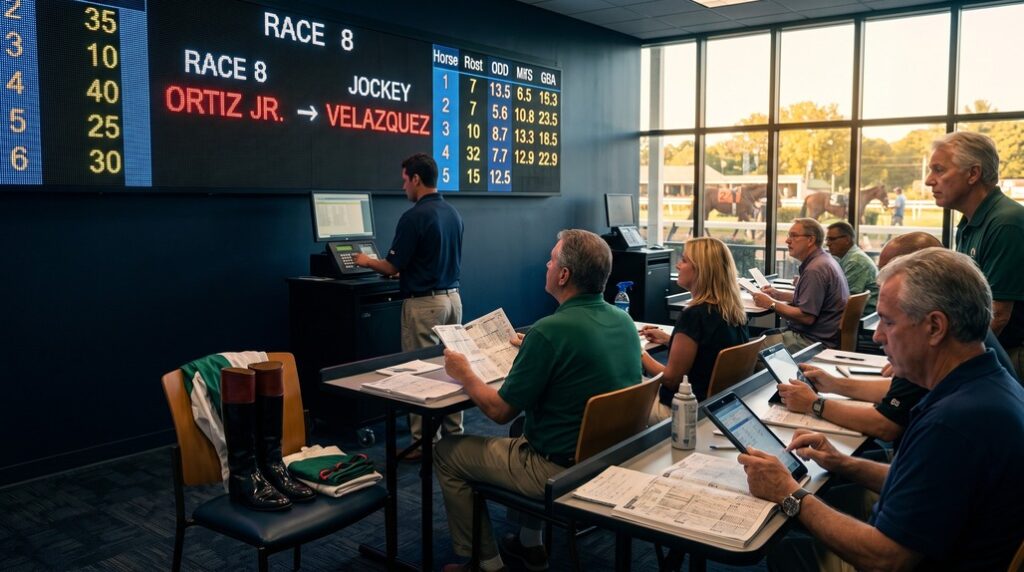
Saratoga’s July 12 Race 4 became a betting lesson before the field ever reached the gate. A maiden turf race for 2-year-olds, originally carded at one mile on the inner turf, was changed by order of the stewards to 1 1/16 miles after jockeys raised safety concerns about the short run into the first turn with a large field of inexperienced horses. The change delayed the race by about 40 minutes, forced NYRA to cancel the day’s Pick 6, moved a $166,072 carryover to the next Thursday card, and turned Race 4 into an “ALL” leg for some multi-race wagers already underway.
For horseplayers, that sequence should matter long after the frustration fades. The issue was not only whether the right safety call was made. It was when the call was made, how clearly it was communicated, and how much wagering strategy had already been built around a race that no longer existed in its original form. Racebook Review readers who followed the recent Kathynmarissa Diana Stakes betting analysis saw how Saratoga turf prices can shift around trainer intent, weather, surface condition, and public reaction. Race 4 added another factor: late safety decisions can change the actual betting product in minutes.
Why Race 4 Became A Betting Flashpoint
The July 12 fourth race was not a Grade 1, a Travers prep, or a nationally branded stakes. It was a 2-year-old maiden race on the inner turf. That is exactly why the disruption matters. If a routine-looking race can alter the day’s Pick 6, delay the card, and force bettors to recalculate multi-race exposure, then every serious Saratoga player needs to treat race conditions as live information rather than static print in the past performances.
According to the Times Union’s breakdown of the Saratoga Race 4 confusion, the race was first scheduled for 2:54 p.m. Eastern but did not leave the gate until 3:34 p.m. The delay came after the distance was changed from one mile to 1 1/16 miles, following jockey concerns about the short run into the first turn on Saratoga’s inner turf course.
That one-sixteenth of a mile may sound minor to casual bettors. It was not minor in this context. Saratoga’s inner turf layout creates a different run to the clubhouse turn depending on the distance. With a field of 2-year-olds, many still learning race-day behavior, a short approach to the first turn can increase traffic risk. The Jockeys’ Guild later said the issue was not new and argued that large fields of 2-year-olds at one mile on the inner turf had been a safety concern for decades.
The race still went forward. Heavy favorite Liam’s Law, ridden by Flavien Prat for trainer Todd Pletcher, won gate to wire by 1 1/4 lengths. Yet the result itself became secondary. The real story for bettors was that the race they handicapped changed after wagers had already been made.
How The Pick 6 Cancellation Protected Bettors And Exposed Risk
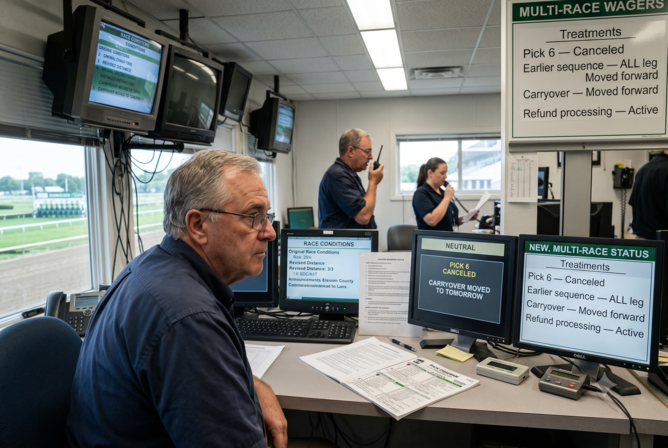
NYRA’s handling of the Pick 6 showed how quickly a safety decision can become a wagering-integrity issue. The Pick 6 was scheduled to begin with Race 4, meaning bettors had built tickets around a one-mile turf race. Once the distance changed, NYRA canceled the wager rather than let those tickets stand under different conditions.
The NYRA announcement on the Race 4 distance change said the change triggered cancellation of Sunday’s $1 Pick 6 and moved the carryover to Thursday’s nine-race card. Thoroughbred Daily News reported that NYRA Chief Revenue Officer Tony Allevato said the decision was made because bettors had handicapped the race at the original distance, and that canceling the wager was the best available way to protect gamblers after safety became the first concern.
That distinction matters. Safety came first. Better protection came second. The problem for horseplayers is that the money had already entered the system. Some wagers could be refunded or adjusted. Some multi-race sequences could be converted to “ALL” for Race 4. The original handicapping work, ticket construction, and expected payout structure could not be fully restored.
That is why late safety decisions should be part of bankroll planning. A bettor who plays every early multi-race sequence at full strength assumes the race conditions are settled. Saratoga’s Race 4 showed that assumptions can fail. The issue is not common enough to scare bettors away from multi-race wagers, but it is serious enough to affect how much capital a player should commit before all safety, surface, and scratch information is stable.
Why The Jockeys’ Guild Statement Matters For Handicappers
The Jockeys’ Guild’s response made clear that the concern was not simply a last-second reaction by riders unwilling to ride. In a statement carried by the Paulick Report on the Saratoga distance issue, the Guild said the Saratoga jockey colony had concerns about 2-year-old maidens racing one mile on the inner turf, especially with a field larger than eight. The statement said the fourth race had been carded with 11 starters and ultimately 10 ran.
The Guild also said NYRA management had been made aware of concerns on Friday, July 10, and that multiple NYRA officials were notified again around 12:15 p.m. on Sunday. NYRA’s public comments, as reported by the Times Union, placed more emphasis on the issue being raised after the start of Sunday’s card. That disagreement over timing became part of the controversy.
For bettors, the timing dispute is not just inside baseball. It shows why horseplayers need to watch how race-day decisions develop, not only what the final decision is. If a safety issue is known before a card begins, bettors reasonably expect clarity before multi-race wagers are locked in. If the issue emerges after riders have evaluated the day’s conditions, then late change risk is harder to avoid.
The Guild’s statement also points to a deeper handicapping issue. Riders know where turns come up quickly, where young horses may struggle with field size, and where rail settings or gate placement can affect fairness. Bettors see the printed distance. Riders feel the geometry. When those two perspectives collide, the market can be caught in the middle.
How A Small Distance Change Can Alter The Race Shape
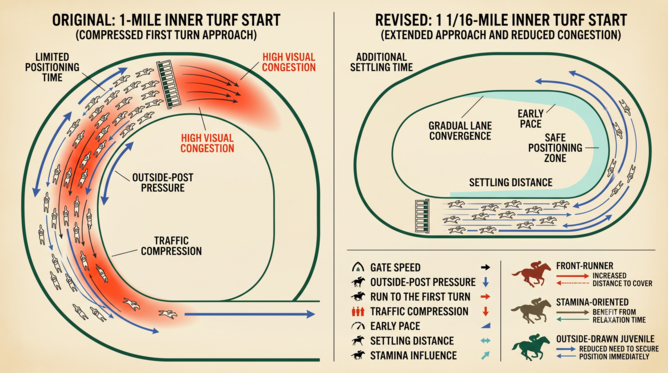
Changing from one mile to 1 1/16 miles on turf is not a clerical edit. It can change pace, position, rider tactics, and which horses are helped. A one-mile inner-turf race with a short run to the turn can favor horses who break cleanly, secure position, and avoid traffic. Extending the distance can give riders a safer approach, but it can also change the amount of time horses have to settle before pressure begins.
In juvenile maiden races, that matters even more. Young horses may be learning to break, rate, handle the crowd, switch leads, or react to other horses around them. A horse drawn outside at one mile may face a different tactical problem than the same horse drawn outside at 1 1/16 miles. A speed horse expected to clear quickly may lose some edge if the longer run changes early positioning. A horse with stamina may become more attractive. A horse with sharp gate speed but unknown finishing ability may become less appealing.
That is why NYRA’s cancellation of the Pick 6 made sense from a betting-fairness standpoint. The race was not the same handicapping problem. Bettors who singled a horse at one mile may not have made the same decision at 1 1/16 miles. Bettors who spread because of the original short-run traffic risk may have structured tickets differently after the distance change.
This should be a lasting lesson. Distance changes are not only track-operations updates. They are price-making events.
Why Late Safety Decisions Can Change Multi-Race Strategy
Multi-race bettors are especially exposed to late operational changes. A win bettor can wait until five minutes before post. An exacta player can rebuild after scratches. A Pick 5 or Pick 6 player often has to commit earlier, especially if a sequence begins before the race where the main opinion sits. That makes late distance, surface, and safety updates more damaging in multi-race pools.
Race 4 shows three different kinds of risk. The Pick 6 was canceled outright because it started with the changed race. Pick 4 and Pick 5 sequences that had begun earlier treated Race 4 as an “ALL” leg. Pick 3s and doubles were handled based on when they started. That creates very different outcomes for bettors depending on which pool they entered.
An “ALL” leg can protect bettors from being knocked out by a changed race, but it can also flatten ticket value. If every live ticket gets through the same leg, the advantage of handicapping that race disappears. A bettor who had a strong original opinion loses the chance to profit from being right. A bettor who had a weak opinion gets rescued. That is fairer than letting the changed race decide the sequence, but it is not the same as the original wager.
The practical adjustment is to keep early multi-race exposure smaller when a sequence includes unstable races: large juvenile fields, turf routes with unusual starts, weather-threatened races, or conditions where rider concerns could plausibly emerge. Saratoga’s Race 4 should push bettors to identify those legs before they build tickets.
Why Saratoga’s Inner Turf Requires Extra Attention
Saratoga’s turf racing is one of the meet’s biggest draws, but it also requires precision from horseplayers. The inner turf and Mellon turf courses can play differently. Rail settings, field size, distance, weather, and horse experience all matter. The July 12 controversy put the inner turf’s one-mile configuration under a spotlight because the short run into the first turn created the safety concern cited by riders.
BloodHorse’s report on the jockey safety concern at Saratoga noted that six of the 10 juveniles who started were making their debut, while the other four were making their first start around two turns. That is a powerful handicapping detail. It means the field was not only young but largely untested in the exact kind of situation that made riders uneasy.
That should affect how bettors treat similar races going forward. A 2-year-old turf maiden race at Saratoga is not automatically unplayable, but it should be evaluated with a safety-and-geometry lens. How many starters are entered? How many are first-time starters? How short is the run to the first turn? Are there several outside-drawn horses with speed? Has the race been written at a distance riders have questioned before?
Those questions do not replace normal handicapping. They sharpen it. A horseplayer who reads the condition book and overnight carefully may spot risk before the broader market does.
How Bettors Should Read Communication Disputes
The disagreement between NYRA and the Jockeys’ Guild over timing is another reason this incident matters. Bettors do not need to take sides to learn from it. The key point is that communication gaps can become wagering gaps. When riders, stewards, management, and bettors are not aligned before the pools open, the risk shifts onto the customer.
The Guild argued that the concerns were raised with enough time to change the race without delaying the card. NYRA pointed to the field being drawn five days earlier and to similar races having been run in 2025, though the Guild said prior comparable races had smaller fields. The Times Union reported that the dispute left fans and bettors frustrated because the distance change came after wagers had already been placed.
For horseplayers, the lesson is to pay attention to friction. If riders speak publicly about a race configuration, if a track has recurring debate over a distance, or if weather and field size create known concerns, bettors should price that uncertainty. That may mean waiting longer to bet. It may mean avoiding early multi-race sequences that start in a questionable leg. It may mean reducing ticket size until the market is stable.
The point is not to assume incompetence. Tracks, riders, and stewards are balancing safety, fairness, scheduling, and wagering obligations. The point is that bettors operate inside that system and need to manage their own exposure when the system is under stress.
Why Late Changes Can Create Bad Price Signals
Late changes can also distort the odds board. When a race is delayed by 40 minutes and conditions change, money enters the pool under unusual circumstances. Some bettors may cancel or avoid the race. Others may chase action because they have waited through the delay. Some may overreact to the new distance. Others may ignore it and bet the same opinion they had earlier.
That can create misleading odds. A horse that drifts may not be weaker; bettors may simply be uncertain. A favorite who stays short may not be stronger; public money may be anchored to the original handicap. In Race 4, Liam’s Law still won as the heavy favorite, but that result should not make bettors dismiss the disruption. A favorite can win a changed race while the process still exposes a market problem.
The bigger risk is in future interpretation. A horse that won at 1 1/16 miles after being entered for one mile now has a past-performance line that may not reflect the original plan. A horse that faded may have been disadvantaged by the added distance. A horse that showed speed may have been asked to run a slightly different race than connections expected. Bettors using that race later should note the change rather than treating it like a normal one-mile-to-two-turn progression.
How Serious Horseplayers Should Respond

The correct response is not to avoid Saratoga or stop playing multi-race wagers. Saratoga remains one of the strongest betting meets in the country. The correct response is to build late-decision risk into the process.
Before committing serious money to a Saratoga sequence, bettors should check official track notices, scratches, surface updates, rail settings, field size, and any reported rider concerns. In juvenile turf races, they should pay special attention to distance and first-turn geometry. In sequences with a carryover, they should be extra cautious because carryover pools attract more money and make players more willing to stretch opinions.
A practical approach is to separate wagers by stability. Races with established older horses, normal distances, clear surface status, and no weather or safety concerns can support stronger opinions. Races with young horses, unusual configurations, large fields, or possible operational changes should either be treated as spread legs or avoided in early multi-race structures.
That may sound conservative, but it is not passive. It is how bettors keep control when the race office, stewards, riders, and track conditions still have the ability to change the product.
What Saratoga’s Race 4 Should Change Before The Next Card
Saratoga’s July 12 Race 4 should become a reference point for every horseplayer who bets early, builds Pick 5 and Pick 6 tickets, or trusts the printed conditions without checking late updates. The race showed that safety can override the original card, that better protection can require cancellations or “ALL” adjustments, and that even a small distance change can alter the handicap.
The best bettors will not remember the incident only as a controversy. They will use it as a checklist. Watch large juvenile fields. Watch inner turf distances. Watch rider statements. Watch steward orders. Watch carryover sequences that begin with unstable races. Watch whether a race has conditions that could still change after the first post.
Late safety decisions are part of modern racing. They protect riders and horses, and they can protect bettors when tracks act transparently. The challenge for horseplayers is to recognize that safety decisions can also reshape value. At Saratoga, the smartest wager may not be the one made earliest. It may be that the one made after the race still looks like the race you actually handicapped.