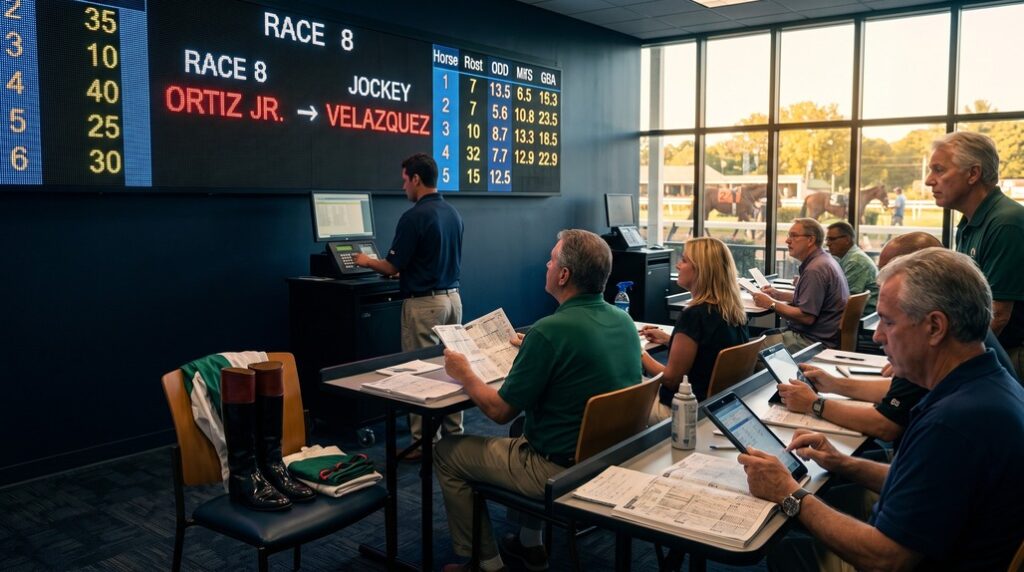
Kathynmarissa’s late run in the Grade 1, $500,000 Diana Stakes did more than give trainer Chad Brown another Saratoga trophy. It gave horseplayers another reminder that Brown’s turf presence at the Spa changes prices before the gates open, especially in elite filly-and-mare turf races where he can enter multiple live runners and shape the public’s entire view of the race. On July 18, 2026, Kathynmarissa closed over a yielding inner turf course to catch stablemate Segesta, while another Brown runner, Portfolio Duration, finished third. That Brown-trained trifecta turned the Diana into both a result and a betting lesson.
Racebook Review readers who followed the recent Golden Tempo Travers betting picture know Saratoga prices are often shaped by more than raw ability. Reputation, trainer intent, race placement, weather, surface condition, and public memory all move the board. Kathynmarissa’s Diana win sharpened that same point on turf: when Brown brings a deep group to a Saratoga grass Grade 1, bettors are not just handicapping horses. They are handicapping the market’s belief that Brown has already solved the race.
Why The Diana Was A Chad Brown Market Before Post Time
Diana was already a Brown race before Kathynmarissa made her move. The Times Union reported that Brown entered four of the seven runners: Kathynmarissa, Segesta, Portfolio Duration, and Dynamic Pricing. That means more than half the field came from one barn, and all four entered with legitimate reasons to take money. Kathynmarissa was a 5-year-old daughter of American Pharoah coming off a third-place finish in the Grade 1 New York Stakes. Portfolio Duration had beaten Kathynmarissa in that New York Stakes. Segesta entered off major Grade 1 credentials, including wins in the Jenny Wiley and Matriarch. Dynamic Pricing had a prior Grade 1 Saratoga form.
For bettors, that creates a special kind of pressure. When one trainer has several contenders, the public may treat the whole race as a Brown puzzle. Instead of asking whether Brown can win, the market begins asking which Brown horse will win. That can compress prices on every barnmate and leave outsiders overlooked, even when one of them has a tactical or surface advantage.
Brown’s Diana record explains why the market reacts this way. Thoroughbred Daily News reported before the race that Brown had won 10 Diana Stakes since 2011, including nine of the previous 10 editions, and that the 1 1/8-mile inner-turf race had become one of the clearest examples of his Saratoga turf control. Brown told TDN that the Diana is a race he points toward every year and that his team works backward months in advance to identify the right horses. Diana Stakes dominance is not a vague narrative in this case. It is a long-running pattern that the betting public knows well.
That is why Kathynmarissa’s win matters for future Saratoga turf betting. Brown’s name does not only identify a trainer. It changes how bettors price probability.
How Yielding Turf Turned Brown’s Depth Into A Bigger Edge
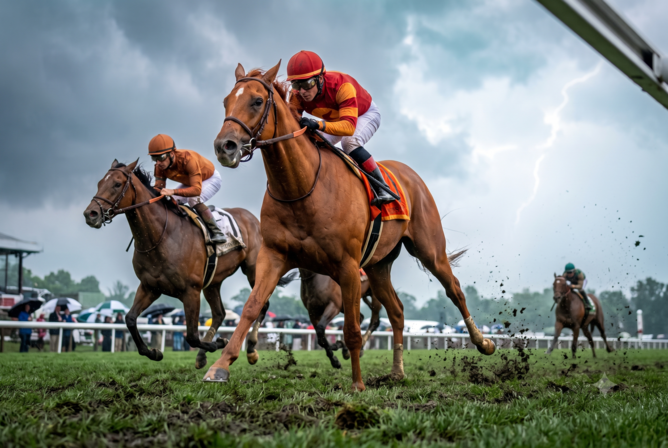
The race-day weather gave Brown another layer of advantage. Rain hit Saratoga during the card, there was a lightning delay, several races were moved off the turf, and the Diana was run on a yielding inner turf course. The Times Union reported that the Diana and the Grade 3 Coronation Cup remained on grass, while other turf races were moved to the sloppy main track. Kathynmarissa then closed boldly to pass Segesta near the wire under Jose Ortiz.
That surface condition matters because soft turf can reward a specific type of horse and trainer preparation. Brown was quoted by the Times Union saying that when there is give in the ground, his horses can get their toe in and accelerate, regardless of position. That is not just colorful post-race talk. It is a handicapping clue. Brown’s turf horses are often built and placed for finish, stamina, and controlled acceleration. On a rain-softened Saratoga course, those traits can become more valuable than early speed or a firm-ground turn of foot.
Kathynmarissa’s race also complicates the way bettors should read future turf form. A horse that handled yielding Saratoga turf on Diana Day may not reproduce the same finish on firm ground. A rival who failed to finish as strongly may not be outclassed; she may simply have been less suited to the going. That matters if these fillies and mares meet again later in the season or if bettors use the Diana as a form reference for another Grade 1.
The public often remembers the trainer sweep more than the conditions. Sharp bettors should remember both. Brown’s trifecta was real, but the turf condition was part of the race. The next time one of these horses appears, the price should reflect whether the surface is likely to help the same way again.
Why Kathynmarissa’s Win Was More Than A Stablemate Shuffle
Kathynmarissa’s win was her first Grade 1 victory, and it changed her profile from consistent top-level participant to proven elite turf mare. Kentuckybred.org reported that Kathynmarissa, bred by Don Alberto Corporation and purchased for $200,000 at the 2022 Keeneland September Yearling Sale, is out of Chilean Group 1 winner La Dalila and had built a record of 14-6-2-3 with more than $1.9 million in earnings after the Diana. Kathynmarissa Diana Stakes win adds important context because this was not an anonymous longshot popping up in a wet-weather race. It was a well-bred, seasoned mare finally converting high-level form into a Grade 1 score.
That matters for bettors because Kathynmarissa may no longer be priced like a horse trying to prove she belongs. After a Grade 1 win at Saratoga for Brown, the next market is likely to protect her reputation. That does not make her an automatic underlay, but it changes the question. Bettors will need to decide whether the Diana represented a new peak, an ideal setup, or both.
The stablemate dynamic also matters. Segesta made the pace and nearly held. Portfolio Duration, who had beaten Kathynmarissa in the Grade 1 New York Stakes during the Belmont Stakes Racing Festival at Saratoga, finished third. That means the result did not separate the Brown runners by a wide class gap. It showed that race shape, course condition, and timing can move the order among high-quality barnmates.
For future races, the danger is assuming Kathynmarissa has permanently moved past the others. She may have improved. She may also have been the Brown runner best suited to that exact Diana setup. When stablemates trade results across multiple Grade 1 turf races, bettors should resist turning one finish into a fixed hierarchy.
How Brown’s Turf Control Affects Saratoga Odds

Brown’s Saratoga turf dominance has a clear betting consequence: his horses are often expensive. That does not mean they are bad bets. A short price can still be fair if the win probability is higher than the odds imply. The issue is that Saratoga bettors often pay a premium for Brown in turf stakes because his record gives them permission to trust the barn.
In the Diana, that premium was logical. Brown had the record, the depth, the surface fit, and four of seven runners. The outcome validated the public’s broad respect for the barn. But future Saratoga turf races will not all be the Diana. Some will have weaker Brown entries. Some will have stronger European shippers. Some will have pace setups that make the favorite vulnerable. Some will be run on turf conditions that do not help a closer accelerate.
Horseplayers should treat Brown’s Saratoga turf record as a starting point, not a final answer. The real betting work is to identify which Brown horse is the right one, whether the market has overprotected the barn, and whether a non-Brown runner is being ignored because the public is too focused on the trainer angle.
That is especially true when Brown enters multiple runners. A four-horse entry group can create confusion. Casual bettors may spread across the barn in multi-race wagers, lowering the value on all of them. More serious bettors need to isolate intent. Which horse was pointed to the race months in advance? Which one needs softer turf? Which one is using the race as a stepping stone? Which one has the rider assignment that signals confidence? Which one has a pace scenario that actually fits?
Brown can control the race without making every Brown runner a fair price.
Why Saratoga Turf Bettors Need To Price Weather Faster
The Diana card was a case study in weather’s effect on turf betting. Race 4, Race 11, and Race 12 were moved off turf during the card, while the Diana stayed on grass. The main track was listed as muddy and sealed after rain and lightning, and the turf course moved from firm to good to yielding as the day changed. Those shifts forced bettors to update assumptions in real time.
That kind of day rewards horseplayers who can adjust before the market fully settles. A horse that is ordinary on firm ground may become more attractive on yielding turf. A pace horse that looked dangerous early in the day may become less reliable if the course becomes tiring. A closer with proven soft-ground ability can become more valuable, especially in a race where the trainer knows how to prepare turf horses for that kind of finish.
Brown’s success makes that adjustment harder because the public already expects him to win. If the weather also favors his horses, the price can become too short. But if the market reacts too generally—betting all Brown runners without separating their ground preferences—there may still be value inside the barn.
Kathynmarissa’s Diana win should push bettors to watch Saratoga weather and course listings as seriously as they watch scratches. On grass, the difference between firm, good, yielding, and soft is not cosmetic. It can change the actual race.
What The Brown Trifecta Means For Multi-Race Wagers

The Brown trifecta creates a specific problem for Pick 4, Pick 5, and Pick 6 players. When a trainer dominates a turf stakes field with multiple entrants, ticket construction can become expensive fast. Singling the wrong Brown horse can destroy a strong sequence. Using every Brown horse can make the ticket too broad. Ignoring the barn can be reckless when the race history is this strong.
The best answer is not automatic spreading. It is scenario-based coverage. If the race shape clearly points to one Brown runner, a single can be justified. If the surface condition is unstable and multiple barnmates benefit from the uncertainty, deeper coverage may be needed. If the public is overbetting the entire Brown group, using one outsider as a saver can make sense.
The Diana also shows why bettors should not treat all Grade 1 turf races as equally chaotic. A race can have a field of accomplished mares and still be controlled by one barn’s depth. Brown had the favorite types, the proven Grade 1 performers, the local turf experience, and the weather fit. That does not guarantee a sweep, but it explains why the trifecta was not a fluke.
For future Saratoga turf sequences, the question is whether a similar structure exists. Does Brown have multiple logical runners? Are they complementary or redundant? Is there a pace outsider who can disrupt the barn? Is the turf condition likely to favor acceleration or speed? Those are the questions that determine whether a race is a spread, a single, or a pass.
Why The Diana Result Could Shape The Filly-And-Mare Turf Division
Kathynmarissa’s win also matters beyond Saratoga. The Diana is one of the country’s major filly-and-mare turf races outside the Breeders’ Cup, and Brown’s comment to TDN before the race described it as one of the biggest races in the division outside the championship event. That makes the result a form reference for late-summer and fall turf planning.
The issue for bettors is how to translate that form. A Diana win over yielding Saratoga turf is valuable, but it does not answer every question. Can Kathynmarissa produce the same finish on firmer ground? Is Segesta more dangerous if allowed to control a slower pace? Did Portfolio Duration lose ground in reputation, or did she simply find the conditions less ideal after her New York Stakes victory? Did Dynamic Pricing’s late entry after rain expectations signal a horse whose best chance depends on surface give?
Those details will matter when these mares return. A horseplayer who only sees “Brown swept the Diana” may miss the more useful angles. Brown’s dominance identifies the trainer trend. The race shape identifies the betting opportunity.
Kathynmarissa now becomes a higher-profile name, which means her next price may be less forgiving. Segesta and Portfolio Duration may offer better value if the market overreacts to the Diana order. Dynamic Pricing may remain condition-dependent. Each one needs to be priced as an individual, not only as part of the Brown machine.
What Bettors Should Watch In Brown’s Next Saratoga Turf Spots
Diana confirmed that Brown still controls Saratoga turf prices because he controls both performance and perception. He wins often enough that bettors have to respect him, and he enters enough live runners that the market has to solve him before it can solve the race. Kathynmarissa’s win added another Grade 1 data point to that pattern.
The next step for horseplayers is to watch how the market responds. If Brown’s future Saratoga turf runners become too short simply because of the Diana sweep, there may be value elsewhere. If the public tries to beat him on principle, his best-placed runners may still be playable. The edge is not blind loyalty or blind opposition. It is knowing when the odds have moved past the evidence.
Kathynmarissa’s Diana win should stay in the notebook as a clean example of Saratoga turf handicapping in 2026: elite trainer intent, multiple stablemates, weather-altered turf, a strong late finish, and a public market that had every reason to expect Brown to matter. The result was familiar, but the betting lesson remains current. At Saratoga, Brown’s turf power is not just a racing story. It is a pricing story.