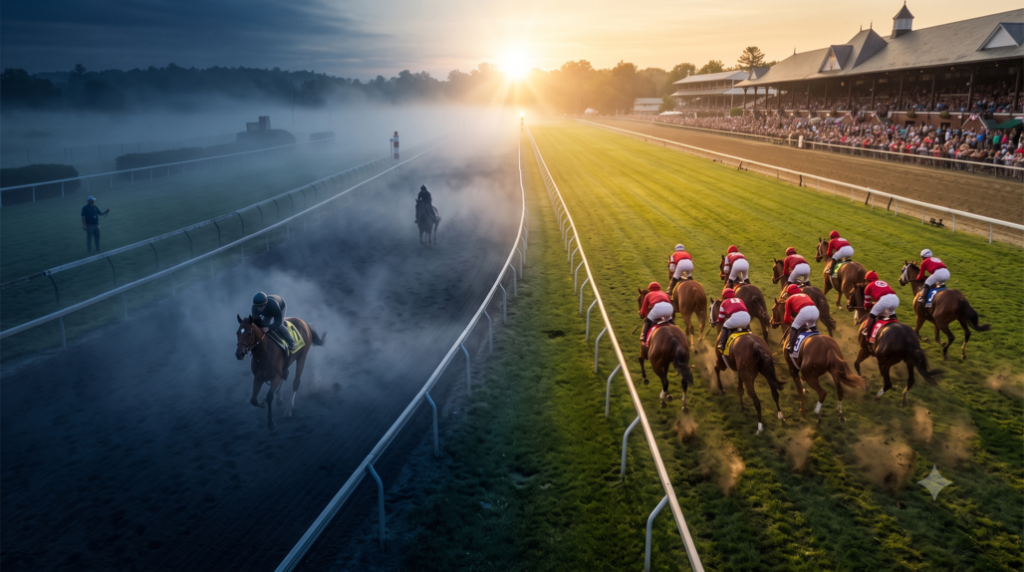
Saratoga’s late-summer calendar is becoming a timing test for horseplayers. The 2026 summer meet already carries extra weight because it runs 46 racing days from July 3 through Labor Day, September 7, before Belmont Park’s rebuilt racing schedule comes back into view. Now the final month adds a sharper betting question: should players attack the big cards early, wait for scratches and surface clues, or save bankroll for Travers week when the pools, public attention, and race quality all peak at once? NYRA’s official stakes schedule lists 73 stakes worth more than $23.575 million, including 20 Grade 1 races, with the $1 million Whitney on August 8 and the $1.25 million DraftKings Travers on August 29 serving as the meet’s two biggest dirt-racing anchors.
Racebook Review readers who followed the recent Saratoga four-day racing week’s strategy already know the 2026 meet has not played like a normal Saratoga season. The four-day rhythm, expanded summer dates, high-value stakes, and Belmont Park transition have made scheduling part of the handicap. Late August now raises the next version of that same problem: timing the wager may matter almost as much as picking the horse.
Why Saratoga’s Final Month Changes The Betting Calendar
The final month of Saratoga is not spread evenly. The meet moves from the Whitney card into turf Grade 1s, New York-bred stakes, juvenile races, Alabama Day, Travers week, and the closing Labor Day stretch. NYRA’s schedule shows the Christophe Clement Turf on August 15, the Alabama and Ballston Spa on August 22, then a stacked August 29 Travers Day with the DraftKings Travers, Personal Ensign, Forego, H. Allen Jerkens Memorial, Lake Placid, and Resorts World Casino Ballerina among the major events.
That structure changes how bettors should manage attention. A horseplayer who treats every Saratoga card as equal may miss the larger rhythm. Some cards are information cards. Some are betting cards. Some are trap cards, where strong race quality produces short prices and limited edge.
The late-summer period rewards players who divide the meet into stages. Whitney weekend sets the older-horse and Breeders’ Cup Classic tone. Alabama weekend tests 3-year-old fillies and turf mares. Travers week creates the largest public narrative around 3-year-old males. Closing weekend can produce juvenile clues, New York-bred form, and horses making one final Saratoga start before the circuit shifts.
The edge is not betting more. The edge is knowing when the market is likely to overprice reputation.
Why Travers Week Forces A Different Bankroll Plan

Travers Day has a different wagering profile than a normal Saratoga Saturday. NYRA lists the DraftKings Travers as a Grade 1 race for 3-year-olds at 1 1/4 miles on dirt with a $1.25 million purse, and the day includes multiple Grade 1 races across dirt and turf. That kind of card draws casual racing fans, national handicappers, bigger pools, and stronger public opinions.
That is good for serious bettors, but only if they enter with a plan. Bigger pools can create better payouts, yet they can also make players overextend. A bettor who tries to attack every major race with equal force may spread too thin before the best opinion arrives.
The smarter approach is to decide before race day which races deserve capital. A strong opinion in the Forego may be more valuable than a forced opinion in the Travers. A vulnerable favorite in the Personal Ensign may create a better Pick 5 path than a heavily debated 3-year-old feature. Saratoga’s biggest day does not require a bet in every famous race.
Timing matters here. Early-week opinions can be useful, but final decisions should wait for post positions, scratches, track conditions, and weather. Saratoga has already shown during the 2026 meet that late safety and surface decisions can reshape wagers. By Travers’ week, the cost of stale information becomes even higher.
How Post Times And Gates Change Player Behavior
NYRA’s summer events schedule lists the first post at 1:10 p.m. on most days, 12:35 p.m. on Saturdays, 11:45 a.m. on Whitney Day, and 11:05 a.m. on DraftKings Travers Day. Admission gates open at 11 a.m. on most live-racing days, with earlier gate openings for Whitney Day and Travers Day.
Those details matter for horseplayers using multiple accounts, watching tote movement, or betting late. The earlier first post compresses the morning routine. It leaves less time between scratches, weather updates, paddock reads, and the start of multi-race sequences. Bettors who normally wait until noon to finalize tickets can be behind the market on Travers Day.
The same applies to app-based betting. Many players are no longer only standing at the windows. They are monitoring live odds, replays, scratches, and account balances from phones. That makes betting speed and timing part of the modern Saratoga experience. Bettors comparing platforms, promotions, and app usability may look at outside resources such as a BetAnything online betting app review while deciding how they want to manage wagering access during a major racing weekend.
The point is not that an app creates a winning opinion. It does not. The useful question is whether the bettor has reliable access to information and enough discipline to avoid rushing into bad prices once the card starts moving.
Why Late-Summer Turf Races Need Separate Treatment
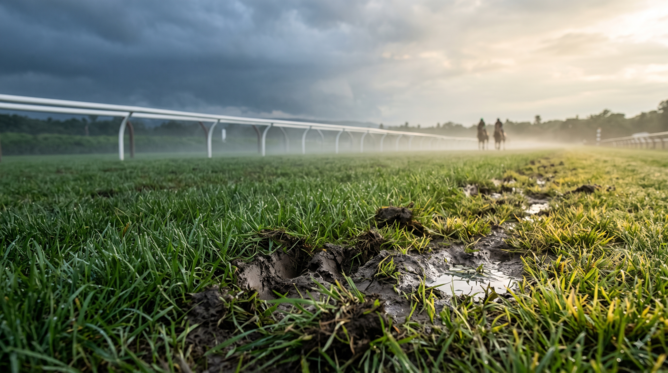
Saratoga turf betting becomes harder late in the meet. By mid-August, the course has absorbed weeks of racing, weather, rail movement, and maintenance decisions. NYRA’s late-season schedule includes turf stakes such as the Christophe Clement Turf, Ballston Spa, Lake Placid, Waya, West Point, Yaddo, and Gio Ponti.
That means turf form should not be treated as one category. A horse that loved firm ground in July may face a different profile in late August. A closer who looked explosive on yielding turf may be overbet next time if the course firms up. A front-runner who failed on soft ground may rebound when conditions change.
Trainer intent also matters. Saratoga’s turf stakes attract barns that point horses to specific spots months ahead. When a trainer waits for a late-August turf race, the timing can be a signal. When a horse appears quickly after a hard race, that can be a warning. The public often remembers the last finish. Sharp bettors should remember the conditions behind that finish.
Late-summer turf races can create value when the board prices reputation rather than fit.
How Juvenile Races Can Create Long-Term Betting Notes

The final weeks of Saratoga are especially important for 2-year-olds. NYRA’s stakes schedule includes races such as the Bolton Landing, Skidmore, Spinaway, With Anticipation, Seeking the Ante, and Hopeful. These races may not drive the same immediate public handle as the Travers, but they can shape future betting markets.
Juvenile races are valuable because they create notes that carry forward. A horse that breaks slowly, handles traffic, finishes with energy, or struggles with the Saratoga surface may become a better bet later when the crowd only sees a finishing position. A juvenile who wins by open lengths may become a poor next-out price if the race setup was perfect.
This is where timing changes again. Bettors do not need to play every 2-year-old race aggressively. Sometimes the best value comes from watching closely, saving notes, and waiting for the second or third start. Saratoga’s late-summer juvenile races are often less about one-day profit and more about building an information edge before the fall.
The same logic applies to future Breeders’ Cup Juvenile and Juvenile Fillies discussions. A sharp Saratoga performance can move quickly into national conversation. The bettor who watched the race shape, not just the replay highlight, may have the better read.
Why Bigger Cards Can Produce Worse Favorites
Saratoga’s biggest cards bring deeper pools, but they also create famous favorites. The Whitney, Alabama, Travers, and Hopeful all attract horses with strong public identities. Some deserve short prices. Others become short because they are easy for casual bettors to recognize.
That is where late-summer timing becomes a market edge. If a favorite is likely to be overbet by Saturday afternoon, early confidence can help. If the favorite depends on weather, surface, or scratches, waiting may be safer. If the favorite is part of a multi-race sequence where everyone wants to single, opposing that horse can create leverage.
The best Saratoga players do not decide by fame. They decide by price. A 6-5 horse can be fair. A 3-1 horse can be terrible value. The public narrative tells only part of the story.
Late August makes this more visible because major races attract more narrative money. The Travers favorite may be priced off Triple Crown memory. The Alabama favorite may be priced off one dominant win. A turf favorite may be priced off a trainer’s Saratoga reputation. A juvenile favorite may be priced off a fast workout.
Each case requires the same question: is the market paying for probability, or is it paying for comfort?
How Bettors Should Build A Late-Meet Saratoga Notebook
Official Saratoga race results and charts matter, but they are only the start.A late-meet Saratoga notebook should separate race results from betting lessons. The win chart matters, but it is only the start. Bettors should record pace, surface condition, rail setting, field size, scratches, tote action, and whether public money was right for the right reason.
Useful categories include:
- Horses who won with perfect trips and may be overbet next time
- Horses who lost ground, faced traffic, or ran against the race shape
- Turf runners whose form depends heavily on course condition
- Juveniles who showed professionalism beyond the finishing position
- Favorites who attracted money from reputation rather than setup
That notebook becomes more useful as Belmont Park’s return nears. Saratoga form will travel into the fall, but not all Saratoga form deserves equal treatment. A late-August win at the Spa can become expensive in the next market. A hidden late-August loss can become profitable if the horse returns under better conditions.
Why Timing Is The Real Late-Summer Edge
Saratoga’s late-summer stakes calendar is turning betting timing into a bigger edge because the meet is no longer just a collection of great races. It is a sequence of market events. The Whitney changes older-horse prices. The Alabama changes the 3-year-old filly’s perception. The Travers changes the entire 3-year-old conversation. Juvenile stakes create future money. Closing-week races sort horses before the New York circuit moves downstate.
The best bet is not simply the one with the strongest opinion on paper. It is the one who knows when that opinion should become a bet.
Early can be useful when the market is likely to move in the right direction. Late can be safer when scratches, weather, and surface changes matter. Passing can be strongest when the race quality is high, but the price is wrong.
That is the Saratoga lesson for the rest of 2026. The meet’s biggest races will create headlines. The better horseplayers will be watching the clock, the board, the conditions, and the way public money turns a good horse into a bad bet.