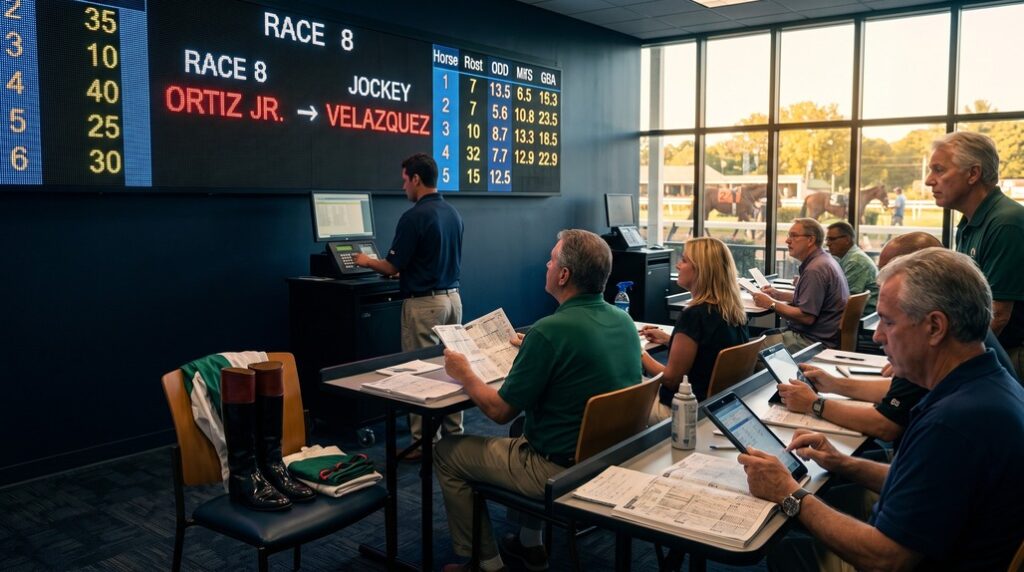
Golden Tempo’s Belmont Stakes victory did more than close the 2026 Triple Crown season. It reminded horse racing fans that the smartest reading of a race often happens between the odds board and the storyline, not inside either one alone.
On June 6, 2026, Golden Tempo won the 158th Belmont Stakes at Saratoga Race Course, defeating Commandment and race favorite Renegade in the final leg of the Triple Crown. The win gave Golden Tempo a Kentucky Derby-Belmont double after connections skipped the Preakness Stakes, a decision that now looks less like caution and more like a defining example of modern race management.
For bettors, though, the deeper lesson was not simply that Golden Tempo was good enough. It was that racing markets, offshore sportsbook chatter, and public contender hype can all point in different directions. The Belmont showed why serious horse racing fans need to separate track odds, pari-mutuel movement, and offshore sportsbook narratives before treating any number as a true signal.
Golden Tempo Turned The Belmont Into A Market Lesson
Golden Tempo entered the Belmont with a complicated profile. The Kentucky Derby win had already proved elite ability, but skipping the Preakness changed the public debate. Some fans saw freshness. Others saw uncertainty. Renegade, who had chased Golden Tempo in the Derby and entered the Belmont as a major threat, carried the kind of storyline that can easily dominate betting conversation.

Then the race unfolded, and Golden Tempo answered with performance rather than noise.
At Saratoga, over 1¼ miles instead of the traditional 1½-mile Belmont distance, Golden Tempo produced the kind of finish that made the pre-race debate look too narrow. The victory was not only about talent. It was about timing, recovery, placement, and the confidence of trainer Cherie DeVaux and jockey José Ortiz in a campaign built around the horse’s best possible version.
That matters for bettors because the Belmont is not always won by the horse with the loudest market story. It is won by the horse that fits the race, the distance, the pace shape, and the moment.
Track Odds Are Not The Same As Offshore Sportsbook Buzz
One of the easiest mistakes for newer racing bettors is treating all odds as if they mean the same thing. They do not.
Traditional horse racing odds in the United States are usually pari-mutuel. That means the odds are shaped by the money in the pool and can shift until betting closes. The track odds reflect how the betting public distributes money across the field. They are not fixed predictions, and they are not always efficient indicators of a horse’s real chance.
Offshore sportsbook discussion works differently. It can be shaped by fixed-odds pricing, promotional framing, market access, regional restrictions, or forum momentum. That does not make it useless, but it does mean bettors need to read it with caution.
A Belmont contender can become popular in offshore sportsbook conversations because of a Derby narrative, a trainer reputation, a viral workout clip, or a perceived “value” angle. But if that hype is not tested against race shape, pace, distance, and official track-market movement, it can become more distracting than helpful.
For readers who want to compare how offshore operators are reviewed outside the racetrack environment, a detailed Bovada sportsbook review can provide useful context on risk signals, platform structure, and the difference between sportsbook evaluation and race handicapping.
Why Saratoga Made The 2026 Belmont More Complicated
The 2026 Belmont was not the old Belmont in every practical sense. Saratoga Race Course gave the event a historic and electric setting, but the temporary move from Belmont Park changed the race’s structure. The 1¼-mile distance brought it closer to the Kentucky Derby than the traditional “Test of the Champion” format at 1½ miles.
That created a different handicapping puzzle.
A classic Belmont at Belmont Park often rewards long-range stamina, rhythm, and the ability to stay efficient through a demanding final quarter-mile. Saratoga’s version still requires class and stamina, but it can place more emphasis on tactical timing, acceleration, and trip management. Horses that might have looked vulnerable in a marathon-style Belmont could become more dangerous at 10 furlongs.
Golden Tempo’s win showed why bettors had to adjust their assumptions. This was not a race to handicap only through the old Belmont lens. It required understanding how Saratoga’s configuration, field size, pace expectations, and recent Triple Crown campaigns interacted.
| Betting Signal | What It Can Show | Why It Can Mislead |
|---|---|---|
| Track Odds | Real-time pari-mutuel money from race bettors | Late movement can reflect crowd behavior, not certainty |
| Offshore Buzz | Wider sportsbook and forum conversation | Hype can detach from race conditions |
| Past Performance | Proven class and race history | Prior form may not match the current setup |
| Trainer Strategy | Campaign intent and recovery management | Public assumptions may underestimate long-term planning |
The lesson is straightforward: a smart bettor does not ignore the market, but also does not let the market do all the thinking.
DeVaux’s Campaign Decision Changed The Narrative
Cherie DeVaux’s decision to bypass the Preakness with Golden Tempo became one of the defining choices of the 2026 Triple Crown season. In older racing conversations, skipping the middle jewel after winning the Derby can be treated as a missed opportunity. In the modern era, it can also be seen as a disciplined move built around horse care, spacing, and peak performance.
Golden Tempo’s Belmont win strengthened that second interpretation.
The result suggested that the connections understood the horse’s recovery window better than the public did. Instead of chasing every available classic race, they targeted the one that gave Golden Tempo the best chance to confirm elite status. That is a crucial distinction for bettors because campaign decisions are often more meaningful than surface-level chatter.
A horse skipping a race is not always a red flag. Sometimes it is a strategy. Sometimes it is a sign that the barn is thinking beyond tradition and focusing on condition, timing, and the long-term arc of the season.
For racing fans still learning how different wagers interact with race-day strategy, RacebookReview’s guide to Kentucky Derby bet types offers a useful foundation. Understanding the difference between win bets, exactas, trifectas, and deeper exotic structures makes it easier to see why one overhyped contender can distort an entire betting approach.
Renegade And Commandment Proved The Public Was Not Wrong, Just Incomplete
Golden Tempo’s victory should not be read as a total failure of pre-race analysis. Renegade and Commandment both belonged in the conversation. Renegade had the profile of a serious favorite, while Commandment’s runner-up finish showed that the field had more depth than a simple Golden Tempo-versus-Renegade storyline.
The issue is not that public bettors liked the wrong horses. The issue is that major race narratives can become too compressed. Once a favorite emerges, every other discussion tends to orbit that horse. Offshore forums can amplify that effect because strong opinions travel faster than careful analysis.
The Belmont result was more layered. Golden Tempo had Derby class, added rest, and a running style that fit the Saratoga version of the race. Commandment had enough quality to punish anyone who dismissed the second tier. Renegade remained talented but did not own the race simply because the market leaned that way.
That is where horse racing remains different from cleaner head-to-head sports markets. A race is not one team against another. It is pace pressure, traffic, distance, surface, jockey timing, trainer intent, and crowd psychology all unfolding at once.
The Offshore Sportsbook Angle Requires Extra Caution
Offshore sportsbooks occupy a different space from regulated U.S. pari-mutuel racing pools. Some racing fans research them because they are looking for alternative markets, broader sports coverage, or different betting formats. But that research should not be confused with official racing analysis.
A sportsbook page can help readers understand platform reputation, general betting terms, restrictions, payout considerations, and user-risk signals. It cannot replace the work of reading a race.
That distinction is especially important after a race like the 2026 Belmont. When a Derby winner skips the Preakness and returns to win the Belmont, the hindsight narrative becomes powerful. People may say the signs were obvious. They were not. The signs had to be weighed carefully against market behavior, race conditions, and the specific structure of Saratoga’s temporary Belmont setup.
Offshore hype can make a bettor feel like the answer is already public knowledge. Horse racing rarely works that cleanly.
What Bettors Should Take From Golden Tempo’s Belmont
The practical takeaway from Golden Tempo’s Belmont win is not that favorites should be faded or that Derby winners should always be trusted after skipping the Preakness. That would be too simple.
The better lesson is that bettors need to understand which market they are reading.
Track odds show how pari-mutuel money is moving. Offshore sportsbook talk may show where broader betting attention is forming. Racing analysis explains whether the horse actually fits the race. The best bettors do not collapse those three signals into one. They compare them, challenge them, and look for the gaps.
Golden Tempo exposed the gap between storyline and suitability. The horse had already shown elite class at Churchill Downs, then arrived at Saratoga with rest, purpose, and a setup that rewarded the right kind of late strength. The Belmont win was dramatic, but it was not random.
That is why the 2026 result should stay in the memory of racing fans. It was not only a major Triple Crown moment. It was a reminder that horse racing rewards patience, context, and disciplined interpretation.
The odds board can tell bettors where the money is going. Offshore sportsbook buzz can tell them where the conversation is moving. But the race itself still asks the final question: which horse is actually ready for this exact test?
Golden Tempo answered that question at Saratoga.