The Further Ado Haskell run sits in a useful place for judging the colt’s 2026 season: not a crowning result, not a collapse, but a Grade I check on how far his Derby recovery had really carried him. Further Ado, a 3-year-old trained by Brad Cox, entered the Monmouth Park feature after a Kentucky Derby setback and a Churchill Downs rebound. His third-place finish behind Napoleon Solo and Iron Honor did not give him the automatic Breeders’ Cup Classic berth attached to the race, yet it kept him visible in a division still sorting out its leading names.
Further Ado Haskell Context
Derby-To-Churchill Reset
Further Ado’s season had already taken a sharp turn before Monmouth. On May 2, 2026, he finished 11th in the Kentucky Derby after arriving with high public expectations, a result recorded in a CBS Sports report. For any 3-year-old, that kind of Derby finish can raise two different questions. Was the horse exposed by the demands of the race, or did the race simply fail to reflect his true level?
The answer began to form five weeks later. On June 7, Further Ado won the Grade 3 Matt Winn Stakes at Churchill Downs, a rebound noted by a Kentucky Derby news item that also reported his entry for the $1 million Grade 1 Haskell Stakes at Monmouth Park, scheduled for July 19. That sequence matters. A colt who fails in the Derby and then wins back at Churchill has not erased the Derby, but he has changed the conversation from damage control to reassessment.
What Further Ado Haskell Asked Of Him
The Further Ado Haskell assignment asked whether the Matt Winn win could travel into another Grade I setting. It also placed him in a race with direct national consequences, because the Haskell served as a Win and You’re In qualifier for the Breeders’ Cup Classic. That is a different sort of pressure than a rebound race. It asks a horse to do more than show he is sound and competitive; it asks him to defeat peers with the same late-season targets.
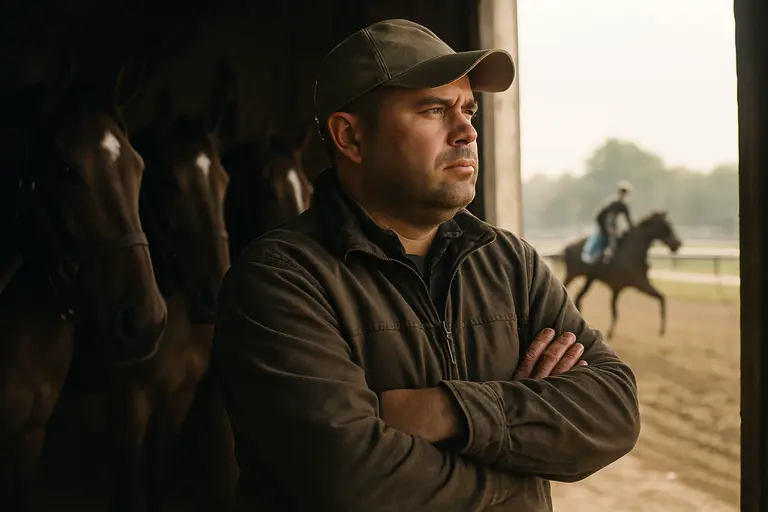
Brad Cox’s public assessment before the race was positive. He said, “I love what I’ve seen from him since. He’s held his condition since. His weight looks great.” That statement does not predict a result, but it tells us the barn saw no obvious regression from the Matt Winn effort. In historical terms, that is often the key after the spring classics. The best summer 3-year-olds are not always the ones who peak earliest; they are the ones who keep enough condition to answer the next Grade I question.
Reading The Monmouth Performance
Post Two And Race Shape
Further Ado drew post position 2 for the Haskell, with Irad Ortiz Jr. listed in the research notes as the rider slated to take the mount. Post position alone does not explain a race, especially without a full chart, margins, sectional times, or track condition in the supplied record. Still, an inside draw in a major 3-year-old race often sharpens the opening stages. A colt cannot afford to lose position, yet he also cannot be spent before the real running begins.
The provided race record lists Further Ado as third, with Napoleon Solo the winner and Iron Honor second. That result gives us a solid performance marker but not a full tactical map. Without official fractions in the research, it would be wrong to claim that the pace helped or hurt him. Without a track-condition note, it would be equally wrong to blame surface or weather. The more careful reading is that he met the Grade I standard well enough to hit the frame, but not well enough to secure the race’s defining prize.
Third Without The Automatic Prize
The Further Ado Haskell assignment had two layers: the race result and the Breeders’ Cup implication. Since the Haskell was a Win and You’re In qualifier for the Breeders’ Cup Classic, only winning would have settled that matter automatically. By finishing third, Further Ado remained short of that guaranteed passage.
That distinction is central to the analysis. Third in the Haskell is not a failed campaign, particularly for a colt who had finished 11th in the Derby earlier in the season. But Grade I racing has a hard edge. A placed finish can confirm quality while still leaving a horse behind the winner in the divisional order. Napoleon Solo took the race. Iron Honor separated Further Ado from the top. Further Ado’s performance therefore reads as credible, competitive, and incomplete.
Brad Cox And The Colt’s 2026 Profile
Condition Between Starts
Cox’s confidence in the colt’s condition before the Haskell is worth weighing against the actual finish. A trainer can report that a horse is holding weight and training well, and the horse can still be beaten by rivals who produce more on the day. That is not contradiction; it is the nature of Grade I competition. The Haskell did not suggest that Further Ado had lost his form. It suggested that his best available form on the day was not enough to defeat Napoleon Solo.
For a racing historian, the interesting part is the arc. Derby disappointment, Matt Winn recovery, Haskell placing: that is a recognizable summer pattern for a 3-year-old trying to rejoin the top tier after the Triple Crown trail. Some horses use such a path to rise sharply. Others remain just below the leaders. Further Ado, through the facts supplied, belongs between those categories. His Matt Winn victory showed he could rebound. His Haskell third showed he could carry that rebound into deeper company, but not yet dominate it.
What The Result Says About His Class
Class in racing is not only a label attached to graded company. It is shown through repeated evidence. Further Ado has evidence on both sides of the ledger. The Kentucky Derby finish was a major negative. The Grade 3 Matt Winn victory was a strong repair. The Haskell third was a qualifying grade rather than a final answer. Taken together, those results make him a colt of standing in the 2026 3-year-old group, but one still needing a Grade I win to change his profile.
For readers who follow the progression of racehorses, Alex Brown Racing offers valuable insights into similar historical race narratives. Horses like Further Ado can only be truly assessed through a series of races, rather than a single performance.
Further Ado Haskell Takeaways
What The Result Says Now
The Further Ado Haskell third-place finish should be read with restraint. It was not the breakthrough that an automatic Breeders’ Cup Classic berth would have represented. It was also not a regression from the Matt Winn. The colt stayed involved at Grade I level, behind Napoleon Solo and Iron Honor, after already proving at Churchill that the Derby had not broken his season.
The key point is that Further Ado’s 2026 profile now has shape. He has a Derby defeat that cannot be ignored, a graded stakes win that shows recovery, and a Haskell placing that confirms competitiveness without settling superiority. That is often where a 3-year-old’s summer identity is formed. The sport remembers the winners first, as it should, but the placed horses in races like the Haskell often tell us which colts are still close enough to matter when the division moves into its next major tests.
For now, Further Ado remains a serious colt with unfinished Grade I business. The Monmouth result did not hand him the season-defining prize, but it gave analysts a clearer read than the Derby alone ever could. He is no longer just the colt who failed to fire on the first Saturday in May. He is a Matt Winn winner and Haskell third, and that combination keeps him relevant in any fair reading of the 2026 3-year-old season.